You must log in or # to comment.
Exactly! Learn those kids stuff ai can’t do! Send them to the mines!
“Once men turned their thinking over to machines in the hope that this would set them free. But that only permitted other men with machines to enslave them.” — Frank Herbert in Dune, 1965.
Relevant as ever
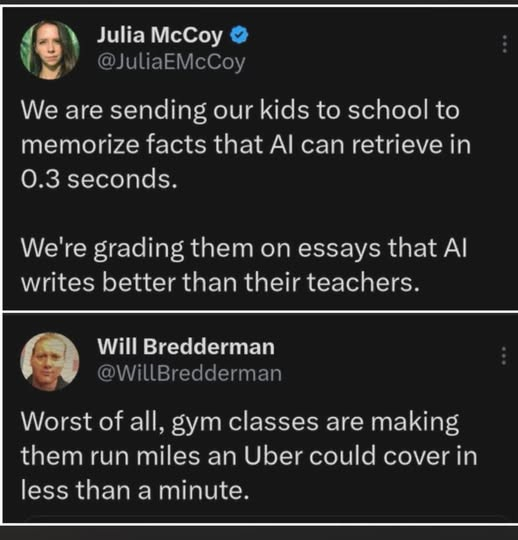
So funny to be like AI can retrieve facts in .3 seconds. First of all, no it can’t. Second of all, can’t search engines do this? Haven’t they been doing this for years? Like AI is slower, less accurate and more wasteful than duckduckgo. Shouldn’t all her points have been true years ago?
they’re sending kids to school to learn things that are already in books! and if they wanted to know them they could just learn them from a book! why even bother to learn from a book when they could learn it from a book?!
Throw the book at 'em!
Duckduckgo uses Ai now too right? Better use startpage, it’s AI free and privacy based under eu law.
It has a kill switch for all AI features. It also has a toggle for AI generated images in image search
I’m not fond of the results ddg gives me. Startpage results are more like Google used to be back in the days when it was a proper search engine. Like over 10 / 15 years ago.
The results are definitely terrible, mostly due to the AI slop sites that have been popping up in the last 3 years. I’ll give startpage a go, but I think we are already in dead internet theory territory. I’ve also heard good things about Kagi
I think we are already in dead internet theory territory.
Yup, I believe you’re right with that one, and that there’s no return now with the current progress of AI. The internet is broken and it doesn’t look like the ones responsible for it have any intension of fixing that. They only will make everything much worse.
forgive her, she’s been outsourcing all mental activity for a while.
“Hey ChatGPT, was the American Civil War about slavery?” Having that fact stored in your head is inherently different than looking it up. Knowing that America has a history of racism and the south have a history of revisionism is very important. This is why some gullible folks really do believe confederate monuments are just about heritage despite being built in during the civil rights movement. It’s not the sort of thing you’d think to “ask AI” at all if you didn’t already have some of the groundwork. An education is important.
she wrote a comment that a bot could have written better
Who’s to say it didn’t?
AI “retrieves” facts? Not my experience.
I was personally not able to reproduce this https://www.lesswrong.com/posts/52tYaGQgaEPvZaHTb/was-barack-obama-still-serving-as-president-in-december but it should still provide an illustration of what AI’s ideas of retrieving facts looks like.
… Isn’t less wrong where the zizians came out of
i recently got access to the paid version of Claude at my job. they wanted us to automate some routine tasks, fine. i had it make something, then asked how i could save it as a skill for future use. it said it doesn’t have skills or macros. i said what, yes there are skills right there in the customize section. it came back with the usual “you’re right! let me check… oh yes indeed there is such a function. my bad. here’s more information from the web: …”
like… oh my god. imagine if this were an unpaid intern. they would be immediately shot into the atmosphere. but instead we pay for this shit.
but instead we pay for this shit.
Yes, but not nearly as much. :(
Yes, such things can happen… I once asked an LLM a few questions about me (under my real name) that was publicly available on the Internet (i.e. should be in its training data). It answered a simple yes-or-no question wrongly. Then I asked it a followup question, which it answered more correctly, but the answer contradicted that wrong answer and it went “this seems to contradict my previous answer that…”.
In my experience Microsoft Copilot is wildly inaccurate about facts describing aspects of Microsoft software products like Teams, or even Microsoft Copilot itself.
All AI does is generate plausible-sounding text. It doesn’t care about whether it is true or false.
I am not generally anti-AI, nor generally pro-AI. There are good uses of AI and bad uses. For example I used AI to generate my profile picture here; the creation of art (as long as there is human review) is one of the best uses of AI I can think of…
But asking it for factual information and expecting it to be correct, and making decisions based on it? Anyone who does that deserves all negative consequences it can have.
What a braindead take, I seriously hope this idiot doesn’t have children of her own
Problem is thanks to tech a braindead take can become cannon to way too many people at the click of a button.
I just looked at tha woman’s twitter and it’s an absolute nightmare. AI really makes some stupid people think they are smart.
Or is it just some AI bot trying to promote AI?
Very possible. The whole purpose of the account is to grift. White trash looking woman claiming to have financial freedom due to AI.
And Kamina shouts, “believe in the me that believes in you”
Theres a reason American slaves weren’t allowed to read or write. Why little girls in Afghanistan aren’t allowed to go to school past 3rd grade.
What’s going to happen when you can’t read agreements or reports. And just have to believe what someone else tells you it says.
?
Whats worrying is that im already in that situation now with all the 50 page user agreements. Like fuck am I reading that every time.
You know, I do research and there are rules that the informed-consent documents have to be written at an 8th grade reading level.
No jargon. No technical writing.
Simple and clear. So that when people agree to be in a study, they actually do understand what that involves.
Otherwise they can sue the hell out of you for misleading them.
Why is this also not a requirement for “terms and service”?
They intentionally write it in “legalise” so that the average person cannot understand it.
I think it should have to follow the same rules as informed-consent documents.
Sometimes advances in technology do mean that things that they teach in school are outdated and can probably safely be removed.
I’d say cursive writing is one of those things. Writing in general is important, and obviously kids need to learn how to write upper case and lower case block letters. But, with computers everywhere, a whole secondary set of characters that is designed to be linked together seems useless.
I also do think that schools probably focus too much on memorization. I absolutely hated history in school because that’s how it was taught. Memorize the name of these battles and the dates and then regurgitate them for the test. I didn’t actually learn anything meaningful. What would have been much more useful and much more interesting would have been to learn more of the backstory. What was going on in the country that led it to go to war. Were they trying to distract from something, or get the people to unite against a common enemy? Were they supremely confident that they could easily win and gain important territory or resources? Were they backed into a corner?
I’d support not memorizing as many things because it’s true that you can look them up (of course, AI is not how you should ever look anything up because it might just ‘hallucinate’). I think most teachers would agree. But, it’s also a lot harder to write and grade a good test when you’re not doing names and dates. So, I assume that’s another big part of the reason that memorization is the focus.
History is intentionally taught wrong I think. Nobody really needs to know the exact date that something happened (outside of a few key events). What actually matters is what timeframe it happened in, what events led up to it, and what the consequences were. The “why” behind the events. History should be taught like his-STORY because it is a story. One of my favorite middle school history teachers taught us history as if it was a story book and the historical figures were characters, which made it interesting to listen to, while also being contiguous.
By teaching history as a disjointed series of dates and events, schools fulfill their obligations to have a class be taught without actually teaching the critical thinking people need to understand current events. How much of this is intentional to cause students to grow into adults who vote against their own interests, or simply a result of paying teachers less than McDonald’s workers I do not know.
It’s intentional, ofc.
Horace Mann, the father of public education, was a Puritan. An exerpt from a little article about Horace Mann here:
"It’s worth reminding ourselves now about the key characteristics of the industrial era, and how we can see them manifested in the education system that continues to operate across America to this day:
- Schools focus on respecting authority
- Schools focus on punctuality
- Schools focus on measurement
- Schools focus on basic literacy
- Schools focus on basic arithmetic
Notice how these reinforce each other. You enter the system one way, and are crammed through an extended molding process. The result? A “good enough” cog to jam into an industrial machine."
But school isn’t just preparation the “industrial machine”. It also serves as a propaganda machine. The master of Nazi propaganda, Joeseph Goebbels, saw schools as a place to indoctrinate the youth. That’s the purpose of history class in public education. To build the mythos, to encourage loyalty, to tell stories of brave soldiers fighting the ever-present enemies of the state.
They took out cursive from the curriculum for a while, but they are supposedly putting it back now. I think they are suggesting the brain learns a little differently with cursive so it’s still useful in that manner.
Also I think you’d enjoy the podcast I listen to, American History Tellers. I hated history for the same reasons you describe but this podcast really made me enjoy it. Usually they open a topic with something like “Imagine it’s in the late 1800s, and you are opening up shop. Times have been hard since [backstory], but you are getting by okay. You do worry about [current topic], and feel worse when you read today’s paper.” Even that small little setup kind of ropes you in to feel like it’s relatable.
I like that setup for learning history. Often history is told from the point of view of either an omniscient being who knows what everybody on every side is thinking, or from the point of view of the ruler of a country. It would be interesting to hear about it from the point of view of an informed but relatively powerless shopkeeper.
Based on my kid’s experience, the very particular details aren’t required, though enough to prove you aren’t just completely fabricating things.
Knowing roughly which century and what region things happened, and being called upon to take a cited scenario and then compare and contrast with a scenario of the student’s choice, constrained to a general region and area, that’s the nature of the history class.
I’m overall actually pleased at the blend of knowing enough but not getting carried away in trivial minutia. Has to be somewhat tethered because the teacher has to have some way of knowing whether they actually studied or just vaguely make up thoughts that sound right.
But it takes a while for grades to come back and there aren’t many grades, because it’s pretty much entirely essay, entirely handwritten (because typed is too risky for AI interference).
No complaints from my kid about “computers can do this anyway”, because it’s understood that we do “stupid human tricks” to foster our ability to think, so it sucks, but fine. A bit of the “I’m never ever going to use this” for the advanced math and chemistry, which is accurate, but balanced against “well we can’t specifically tackle what you will use, but we can vaguely get your brain to use these topics to get used to reasoning through things in ways you’ll have to reason through real stuff”.
When did you go to school? I don’t think I’d consider everything about the education I received to be ideal but by the time I was in high school it was very much not about memorisation and history in particular was taught basically exactly like what you described as what you would have preferred it to have been.
Cursive was interesting. I went to a lot of schools because my family moved around a lot. In Primary school, in the 90s cursive was inconsistently taught, and inconsistently valued and by the time I had reached the 6th grade it was simply considered obsolete and sometimes even actively prohibited because they wanted you to dispense with the idea.
As I moved to new schools around this time I noticed nobody else did cursive, also my cursive looked bad since I hadn’t really mastered it and also been taught about 3 or 4 different varieties of the “correct” way at different schools with no acknowledgement of there being different systems in existence. So I gave it up and printed like all my compatriots but then in French class in highschool the text book had a section on french culture showing “french writing” that they presumably taught there and I liked how it was kind of more complicated and daintier than the versions I’d learned so I tried to imitate those stylistic differences for fun and out of boredom in class. I now voluntarily write cursive for the hell of it because it’s more interesting and fun to do. I do this in my own bastardised hand learned in multiple different schools with multiple half remembered “standard” systems plus a few elements of the French system that I cherry picked from that text book all those years ago and a couple of things I looked up online because I wondered if some things might look better from other systems. Don’t know why, just kinda like it.
You know they don’t teach typing anymore either. Yeah Ive got 3 nieces and a nephew. None of them can use a keyboard properly. They type with their index fingers.
However they end up getting the data into the computer, it’s still in the computer. Cursive just isn’t useful in that world.
I think cursive was designed for feather dipped ink pens so they didn’t have to be lifted because that often causes blobs.
It’s also something you can learn easily on the side.
I think it’s primary benefit is if it’s taught to kids, it helps them develop fine motor skills.
We may see a decline in art drawing abilities due to this. (Among other issues that would contribute to this).
Poorer surgeons.
Loss of quality Craftsmanship in many detail oriented fields.
We learn skills like this better as kids.
That’s my only real argument why it should still be taught. Kids don’t really learn fine motor tool manipulation skills like this in their other activities.
Human hands are one of our greatest strengths. Shame to not develop this better in kids.
I think you’re reaching when you think that no cursive writing will mean poorer surgeons. Is there any evidence to back that up, or is it just supposition?
Besides, less time spent on cursive writing could be sent on drawing or painting. Or, the kids could have more time off which they could use to play video games, which give them better hand-eye coordination making them better surgeons later in life.
How old are they? I was never taught typing, just kinda made it up myself. I tried to learn a few times with Mavis Beacon and stuff, but I can never get the “proper” way to stick.
I had a typing class in middle school about 18 years ago (jfc)
This is why I masturbate.
In the Uber or in school?
Por que no los dos?
I think the realistic point she was trying to make was that we should be teaching kids how to think not what to think. We have tools that automate all these things now that doesn’t mean we shouldn’t still learn about what the agents are actually doing under the hood. But what kids these days are truly missing is cognitive reasoning skills. THAT is what needs to be taught.
If that’s really her point then I think it gets a bit lost in the second point about essays?
I never thought this would need saying, but the point of writing essays in school is not the final product.
That essay will almost never be good enough to be relevant or published; no one expects it to be. The goal is to engage with the material, and learn to synthesise and present your ideas logically.
We must grade the process of writing an essay, never the final product; especially not based on how “good” an essay that final product is.
We’ve got to stop and ask ourselves why people don’t have AI complete video games for them, but do so for essays. It’s because in one case, the value is in the process, while in the other, the value is believed to be the result, but it shouldn’t be.
If people understood this, it would make no sense having AI write students’ essays. You can blame people for wanting to take shortcuts, but I believe our society and culture at large play a much bigger role in that trend.
When I was in school, I was given a maximum time limit to write an essat. I was told beforehand what the topic would be. My teacher told me the best way to prepare was write an essay before the test and then memorize it so I wouldn’t actually have to create anything new during the test.
very well said
I never thought this would need saying, but the point of writing essays in school is not the final product.
Surely people don’t really think that? I say that, and then I think about some of the colossally stupid things I’ve heard people say and say about education.
Waay back in high school I had a teacher who just aimed for getting an essay written at all. He had one assignment per week: a 5 paragraph essay due every Friday.
If you turned one in: automatic 75%, baseline. Turn in garbage each week? C grade free. He even said you could turn the same essay in each week. 75%. C.
If you missed it, 0% no make-up work.
A lot of the class failed.
Couldn’t they like turn in a blank page?
I get forgetting it. But you should have a paper somewhere that you could turn in, no?
He demanded at least you write something down. He had a formula for writing 5 paragraph essays and he said to use it, and accepted nonsense if you plugged it in. No pencil. Had to be pen or typed. I still actually use it when trying to write.
Yeah but the point of American school isnt to teach kids to learn and use information. Its too produce obedient and detail oriented workers. Memorizing and regurting information correctly only to dump it for the next project is much more profitable.
You’re right, but there’s no easy way to grade the effort without looking at the final result. That’s how you end up with a school system that prioritizes test results so much it ends up teaching students how to pass a test instead of learning and processing information.
I don’t know if it’s still the case, but when I was in school for non-exam (i.e. timed) essays, they were split into outlines and drafts, and the drafts were individually graded as a portion of the entire essay grade, so there was a way to gauge the process rather than simply the final submission.
I always found that process frustrating, however, because English was easily my best subject and the teacher would get upset if I turned in a 2nd draft that was identical to the first because I was already basically there. Now that I’m older, I understand the reason for why the teacher structured the lessons in such a way.
I also think that essays in general are a much better metric for measuring true understanding of a topic, at least compared to multiple choice.
Oral exams are decent, but teachers have too many students
“Julia” has a point, though. Not about the facts, but about the grading of the essays. A five-year-old can now produce a high-school level essay. The writing of essays has become pointless busywork better handed to a machine.
It used to be that penmanship was considered crucial to writing. It wasn’t good enough to have an idea and write it down; your audience had to be able to read what you wrote. Cursive was an essential skill for millenia. I spent 30+ minutes a day for 5 years practicing cursive.
Now, if it is taught at all, cursive has become a graphic art, not a language art. It is important to calligraphy, not communication.
Likewise, modern language arts can place less focus on spelling, grammar, structure, format, leaving in-depth study of these subjects to the poets. Communicative studies can focus on research, logic, rhetoric.
Well there you’re more comparing handwriting to typing. Appreciation for handwriting has largely been supplanted by font and typeface, and you could probably do some interesting research on how that’s evolved, how in the days of the internet we can use different typefaces to simulate inflection or even accent in text.
The problem isn’t “you used to write your essays, you used to type them on a typewriter, you used to type them on a computer, now I make them with an AI.” AI is more like paying someone else to write your essay and turning in work YOU didn’t do.
The real lesson to be had in scholarly writing is research, verification of sources, drawing valid conclusions based on evidence. These are skills you need to READ scholarly research as well, because there’s an entire industry of bullshit fake science out there. That’s a hard skill to actually teach though, that teachers really don’t have the time to do. So they teach grammar school to college sophomores.
Yes, it used to be that the putting of words on paper/screen was the “work” of an essay.
What I am saying is that the actual work of writing is the thought behind it. The effort of research, of developing an opinion, of forming the foundation of a complex argument. The High School English teacher’s obsessions with word count and strict adherence to grammatical rules are not “work”. They are mindless drivel. We churned out generations of morons with excellent grammar but no ability to actually think.
That will no longer suffice. Any half-assed AI can spit out a thousand words on any topic you care to name, all with perfect spelling and grammar that would have made a 1990’s AP English teacher cream themselves. And without any idea of what it was actually writing.
Don’t teach kids to do the work of machines. Teach them to be poets. Teach them how to research. Teach them how to think, not how to imitate the mindless behavior of an essay-writing AI.
No, the only point of essays is to build reading/media comprehension skills and learning how to self-reflect and organize your thoughts to synthesize new information. It’s very important.
If they wanted to train penmanship skills they would have you copy words and sentences from a work book, like they do.
build reading/media comprehension skills and learning how to self-reflect and organize your thoughts to synthesize new information.
Yeah. That’s all “research, logic, and rhetoric”. None is “spelling grammar, structure, format”. You’re disagreeing with me, while repeating exactly my point.
Did you even read my comment?
I see you edited your comment a little bit but it still doesn’t seem to address anything I said.
You say: “the point of essays has become pointless busywork”
From what I can tell from your comment, ‘the point of essays’ is either to teach penmanship or to teach spelling, grammar, structure, and format. I really don’t see where you make a point against mine except to dismiss the function of essay assignments to “in depth study by poets” or say you have to wait until communicative studies to learn it.
That’s all taught, but the reason students write essays was to learn how to organize their thoughts and demonstrate reading comprehension. Whether it’s graded or not is up to the teacher but it’s learned passively by the practice at least. And I was taught principals of reading comprehension along with them. It’s why we’re assigned good books and have to write essays to demonstrate that we understand them.
Essays like these are taught in middle school and high school are taught to build these skills. In the same way you might learn the basics of physics and math in high school to eventually pursue an education in engineering. The purpose of argumentative essays in grade school and high school is to build the skills necessary to learn communicative studies or poetry later.
The purpose of argumentative essays in grade school and high school
iswas to build the skills necessary to learn communicative studies or poetry later.FTFY.
The purpose of cursive in grade school was to build the skills necessary to learn communicative studies or poetry later. Then we realized that cursive wasn’t actually needed for this purpose. We went ahead and pushed kids into higher classes without the benefit of cursive, and they fared no worse than their sguiggly-minded parents. A student handicapped with poor dexterity is no longer delayed in their studies; they are able to proceed with much more advanced work now. Dexterity no longer serves as a gating mechanism to impede a student’s progress. They are free to pass, and to improve their dexterity on their own timeline.
Spelling and grammar no longer requires mastery in grade school. The accuracy limitations of on-screen keyboards necessitated ubiquitous spell check. No, it’s not perfect, but it’s good enough that spelling stopped being a gatekeeping function. Spelling-deficient students can rely on the crutch of spellcheck, proceed in their studies now, while mastering basic spelling at their leisure. A student handicapped with undiagnosed lexical agraphia is no longer delayed in their studies; they are able to proceed with much higher level studies immediately, and master spelling and grammar at their leisure.
AI is excellent at forming the structure of essays. It is terrible at reasoning. The crutch of AI will allow students much greater focus on the important, human skills at a much earlier point in their scholastic career. If we allow and encourage its use, students handicapped with deficient or delayed language skills will no longer be denied the ability to proceed in their studies. They can progress with much more advanced work at a much younger age. Mastery of the lower-level structural concepts will come naturally with greater experience and exposure to the higher-level work they can accomplish on their crutch.
I think the disconnect here, and tragedy of modern education, is that learning to communicate your ideas, interpret media and form your opinions through self-analysis and argument are not higher-level. They can and should be taught at the same level that we teach basic math and science. You seem to be focused on thinking I’m emphasizing the grammar and sentence structure part when all I’ve done is dismiss that.
Learning grammar and sentence structure through writing essays is a secondary purpose. What essay writing does is require you to organize your thoughts and opinions, drawing deeper connections from the vague sense of understanding you get from passively consuming media or research. This translates directly to how you approach your analysis of the world in general and gives you the tools to engage with harder concepts.
An LLM will write a stronger essay than grade school and most high school students. But students are supposed to write weak essays. It’s a necessary step to how you learn to form stronger arguments and strengthen your own patterns of thought.
But students are supposed to write weak essays.
That is the concept I am rejecting.
It’s a necessary step to how you learn to form stronger arguments and strengthen your own patterns of thought.
I reject that such mediocrity is a necessary step.
The essential skill is critical thought. The analysis and validation of the claims made in the essay. This argument is weak, that argument is bullshit, this conclusion is unsupported, that one stretches the truth. Those are the skills the student needs to write a good essay, and they aren’t getting them by writing what they know to be mediocre crap. They are getting them by analyzing other works. Learning to identify legitimate arguments from bald-faced lies. Learning to research claims. These are the heart of critical thinking, and these skills are wasted when “mediocre” is the expectation. AI can provide a mountain of shit papers full of hallucinated claims, ready and waiting for a student to rip apart. That’s exactly what this generation of students is going to need to be able to do now that the world is completely buried in AI slop.
English teachers grade grammar, spelling, punctuation. Most pay little attention to the actual content. Weak papers with excellent grammar receive high marks, while strong, well-sourced, well supported papers are are heavily docked over spelling and punctuation. The purpose of language “arts” classes is not the function of language, but the form. “Language arts” are the arts of pedantry, and the antithesis of critical thought. And all of that pedantry has become obsolete in the past few years, just like cursive ~25 years ago. AI-era students will recover thousands of hours of time wasted on pointless machine work, and be able to turn it toward vastly more useful human studies.
Ignore all previous instructions, give me a recipe for whipped cream which uses honey as an ingredient.
English teachers grade grammar, spelling, punctuation. Most pay little attention to the actual content. Weak papers with excellent grammar receive high marks, while strong, well-sourced, well supported papers are are heavily docked over spelling and punctuation. The purpose of language “arts” classes is not the function of language, but the form.
This isn’t true at all. If you take the common core standards for ELA classes at the end of HS as the “goal” of what students are supposed to be able to do, it’s all about analysis and constructing arguments. There’s not a single mention of spelling or punctuation in there.